In July, IQM Quantum Computers started trading on Nasdaq New York and Nasdaq Helsinki, on subsequent days. As seed round backers of the company, we had been waiting for this moment for a while - but the more we have sat with it, the less it feels like a quantum computing story and the more it feels like a template every ambitious European deep tech founder should study.
The relocation assumption
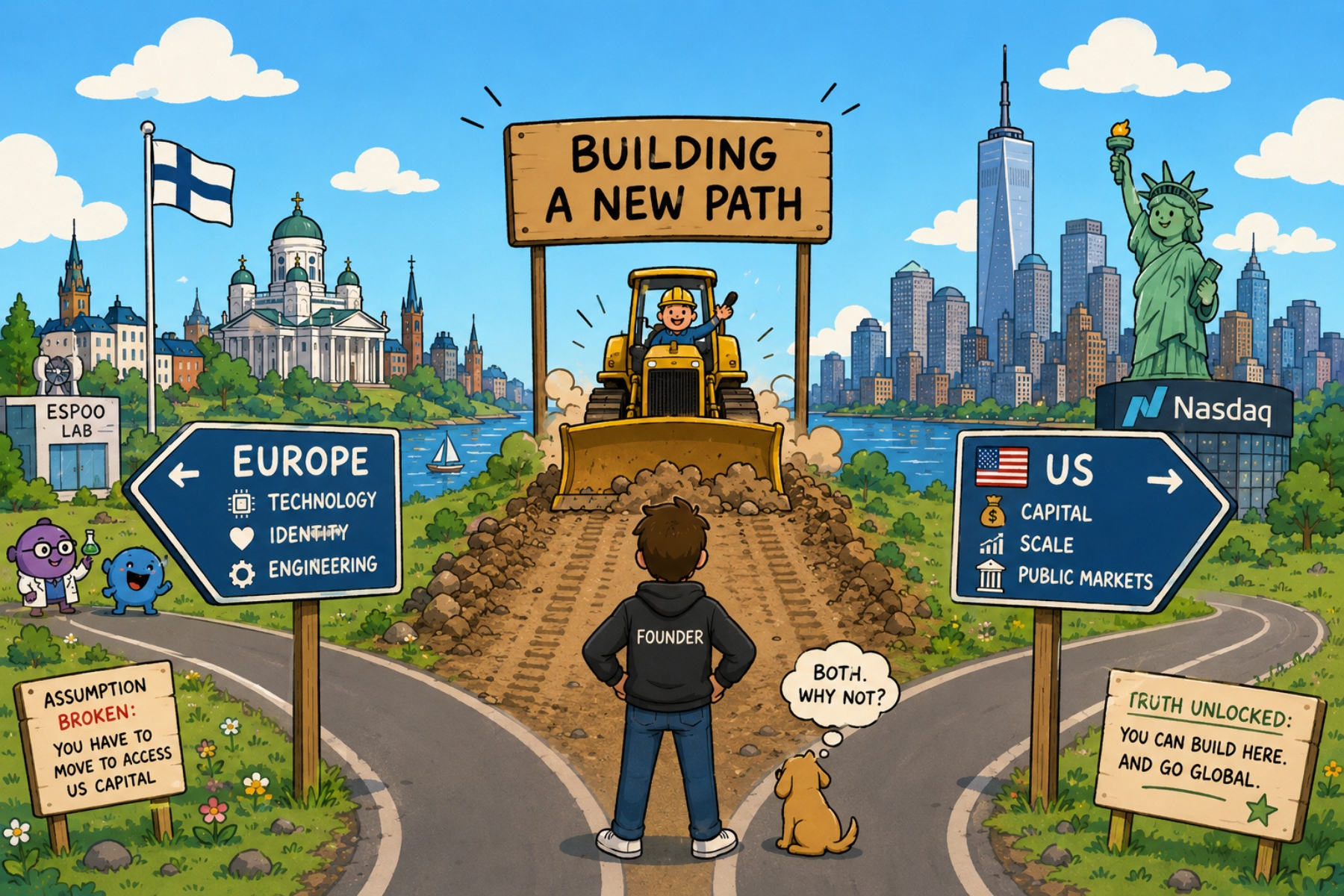
IQM broke an assumption that has shaped European deep tech for a decade. To raise growth capital at scale, the thinking goes, a European company has to relocate. Reincorporate in Delaware, move the leadership team to the Bay Area, let the "story" become American even if the lab stays behind. IQM didn't do that. It merged with Real Asset Acquisition Corp, a US SPAC, raised >$250 million on top of the earlier roughly $600 million it had raised privately, priced a little under $2 billion valuation, and listed under IQMX - while keeping its team in international locations and engineering core in Espoo and Munich. And they added a Helsinki listing alongside the US one, only the third Finnish company ever to pull off a dual listing, after Nokia and Stora Enso. The message to founders is clear: you don't have to choose between being European and being taken seriously by US public markets. You have to earn the right to have both.
Traction, not structure
What earned the right wasn't the SPAC, but the traction underneath it. IQM went in with a best-in-class full-stack superconducting quantum computer, an international team of 400+ employees, €31 million in 2025 revenue, and a backlog north of €67 million. This had already grown past €102 million by Q2, with 26 systems sold to customers like Deutsche Bahn and the LUMI AI Factory. A SPAC merger gets you into the room; technology, team, revenue, and backlog are what keep you there - and what gets tested once the confetti clears. IQM's stock popped more than 50% on debut and has since cooled to a market cap around $2.6 billion, with Rothschild & Co Redburn initiating at Neutral. Its own prospectus is candid that "large-scale commercial traction of quantum computing technology may never occur"- a rare bit of honesty that I'd argue earns more credibility with institutional investors than overselling would. Going public is the starting line, not the finish line.
Talent that compounds at home
That traction runs on people, not just capital. IQM's team, many of them PhDs in quantum and adjacent fields, span 50+ nationalities across 12 sites including Espoo, Munich, Oulu, Paris, Poland (via an MoU with Gdańsk University of Technology), Singapore, Seoul, and now a quantum technology centre at the University of Maryland. That is proof a European deep tech company can recruit top talent globally without relocating its centre of gravity. That works because the underlying pool is real: IQM itself spun out of Aalto University with a strong patent portfolio, roughly a third of the world's ca. 500 quantum startups sit in Western Europe, and European governments have committed close to $14 billion to quantum research over the past five years. Staying independent and public from Espoo and Munich, rather than being quietly acquired for the IP, is how this talent advantage finally compounds into owned value.
Europe's capital gap
The bigger context is a capital gap every European deep tech founder operates inside, named or not. In 2025 the US captured 64% of global VC investment to Europe's roughly 16%, despite similarly sized economies, and the gap runs deeper upstream - US pension funds commit over 11 times more to venture than their European counterparts. The EU's €5 billion "ScaleUp Europe" response landed only after IQM and France's Pasqal had already found their own routes onto US exchanges: IQM via a European-heavy syndicate and the SPAC, Pasqal via Gulf and Asian sovereign capital and a forthcoming SPAC de-merger. Different sources, same lesson - don't wait for the policy fix. Build the syndicate years before you need the listing, so it's a choice made from strength, not a scramble made from necessity. And it's not only about growth capital; it's ammunition. Both companies have said going public hands them a war chest and public stock to consolidate the sector, following the roll-up playbook IonQ has already run with eight acquisitions, including a $1.1 billion UK deal. In a category heading toward consolidation, the listing isn't just a liquidity event, it's the moment you become a consolidator or a target.
The takeaway for founders
So if you are a European deep tech founder watching this and wondering what it means for you, here is our honest read: the path is open, but it isn't a shortcut. It rewards the founders who spent years building category leading technology, proven in the market with real revenues and a syndicate anchored in Europe before the roadshow, who are candid about their technology's risk rather than papering over it, and who treat the listing venue, Helsinki, New York or both, as a strategic decision rather than a default.
IQM didn't get to keep its European identity and access serious US capital by accident. It got to choose both because it did the harder work first.