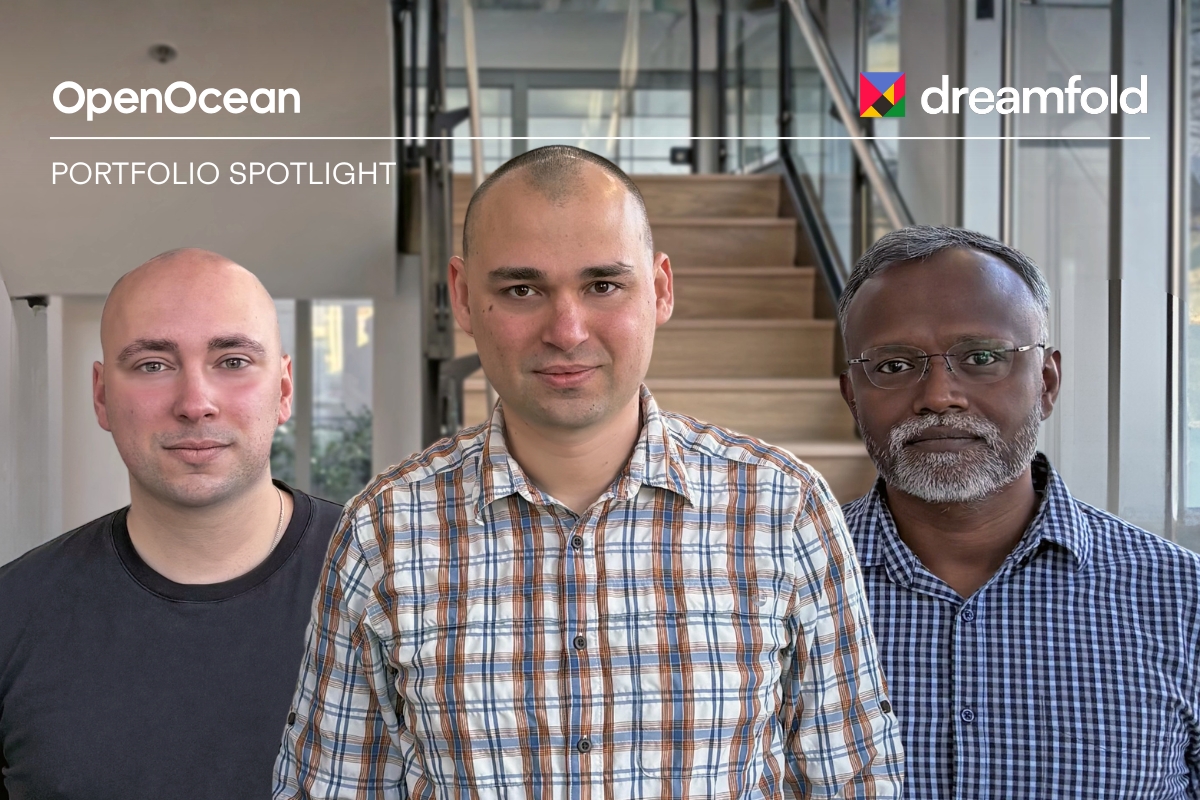
Welcome to our portfolio spotlight series, where we highlight the teams behind some of the most ambitious technical companies. A company is only as strong as the people behind it, which is why we share the stories of the teams driving these disruptive innovations.
Dreamfold’s mission is to design safer, more effective therapeutics for the world’s most challenging diseases, from cancer and immune disorders to infectious diseases and beyond.
Maksym Korablyov founded Dreamfold after nearly a decade developing generative modeling and molecular search algorithms while working alongside Michael Bronstein, a pioneer of geometric deep learning, and Yoshua Bengio, Scientific Director of Mila, A.M. Turing Award recipient, and widely regarded as the “father of deep learning.” Together, they co-founded Mila’s first machine learning group dedicated to drug discovery, producing cutting-edge models including the invention of Generative Flow Networks.
Around the same time, Rajesh Ilango, Dreamfold’s Founding ML Engineer, was a founding member of Nvidia’s Drug‑Discovery Engineering team, where he played a key role in launching Clara Drug‑Discovery and the BioNeMo AI platform for life sciences, leading a team of more than 40 engineers and scientists developing and scaling generative modeling and biomolecular research workflows.
While Maksym and Rajesh were developing leading AI models and computational platforms for life sciences, Dieter Weinand, Dreamfold’s Chairman, was leading one of the world’s largest pharmaceutical companies as President and CEO of Bayer Pharma AG.
Dreamfold has raised funding from IQ Capital, OpenOcean, Ellipsis Ventures, Panache Ventures, and Midas List investors, alongside early founders, engineers, and executives from Cloudera, Meta, and Google. OpenOcean has supported the company at key moments, facilitating strategic conversations and partnerships across its global network.
We caught up with CEO and co-founder, Maksym Korablyov, and COO, Alexandre Stein, to discuss Dreamfold’s origins, the science behind its platform, and how the team is building the next generation of AI-native drug discovery.
What are the problems you see with antibodies today?
When looking at the oncology space, leading therapies targeting the PD1/PD-L1 blockade, such as Keytruda, have helped millions of patients. Yet, in many cases, 60-80% of patients do not see a meaningful response.
On the other hand, bispecific antibodies like Tecvayli offer higher efficacy but carry serious safety risks, with a significant number of patients requiring hospitalization and some experiencing fatal events as a result of the treatment. Similar toxicity risks are seen with other major bispecifics, including Blincyto, Talvey, and Columvi.
Moreover, many high-efficacy assets fail in clinical trials due to toxicity.
Why does this happen?
Even with a strong understanding of pathways and cell biology, it remains challenging for antibodies to affect precise therapeutic interventions without triggering off-disease activity. Drug developers and clinicians are left navigating costly efficacy-to-toxicity tradeoffs when selecting treatment strategies.
How do you address this?
At its core, this is a design problem. Building on our team’s expertise, Dreamfold is developing a purpose-built generative protein design platform to enable safer and more efficacious treatments. With early wet-lab validation in hand, our next step is to validate our designs in increasingly representative disease models. Over time, we believe our approach will materially improve the safety and effectiveness of a significant portion of future therapeutics.
Why is this moment different for drug discovery?
All the essential elements for AI‑led scientific research and discovery are converging. In the process, we’re rapidly and consistently unlocking one novel and traditionally elusive capability after another.
Now, some may ask: why is AI in drug discovery so important? Is it about workflow efficiency, or can it really generate novel discoveries? In reality, it’s both. The space of possible protein sequences is so vast that it is estimated to exceed the number of atoms in the observable universe. Yet, evolution has explored only a tiny fraction of this space, leaving an enormous number of potentially powerful therapeutic proteins unexplored by nature. Adding to the challenge, each unique sequence has its own biophysical properties, causing it to fold into a specific 3D structure, the very shape that determines its function.
Our ability to study the evolved and uncharted protein space has historically been constrained by the time and cost required for data collection and processing. However, after decades of research, the field has entered a new era. Advances recognised by the 2024 Nobel Prize in Chemistry have demonstrated how machine learning can learn representations of the biomolecular world, to accurately predict and generate protein structures, properties, and functions, within and beyond those produced by natural evolution.
Every 12 months, we observe significantly higher performance and new capabilities, including some thought to be many years away. For instance, in 2025, the field has demonstrated that these models can design functional de novo antibodies for a broad range of real drug targets, including traditionally considered “undruggable” targets such as GPCRs. These AI-designed antibodies exhibit important drug-like properties, such as picomolar binding affinities, good yields and immunogenicity within therapeutic range.
The question is no longer whether this is possible, but rather which AI‑enabled discovery will benefit patients first, and which will ultimately have the greatest impact.
Thanks to the entire Dreamfold team for the interview!